Is your Supabase app leaking data?
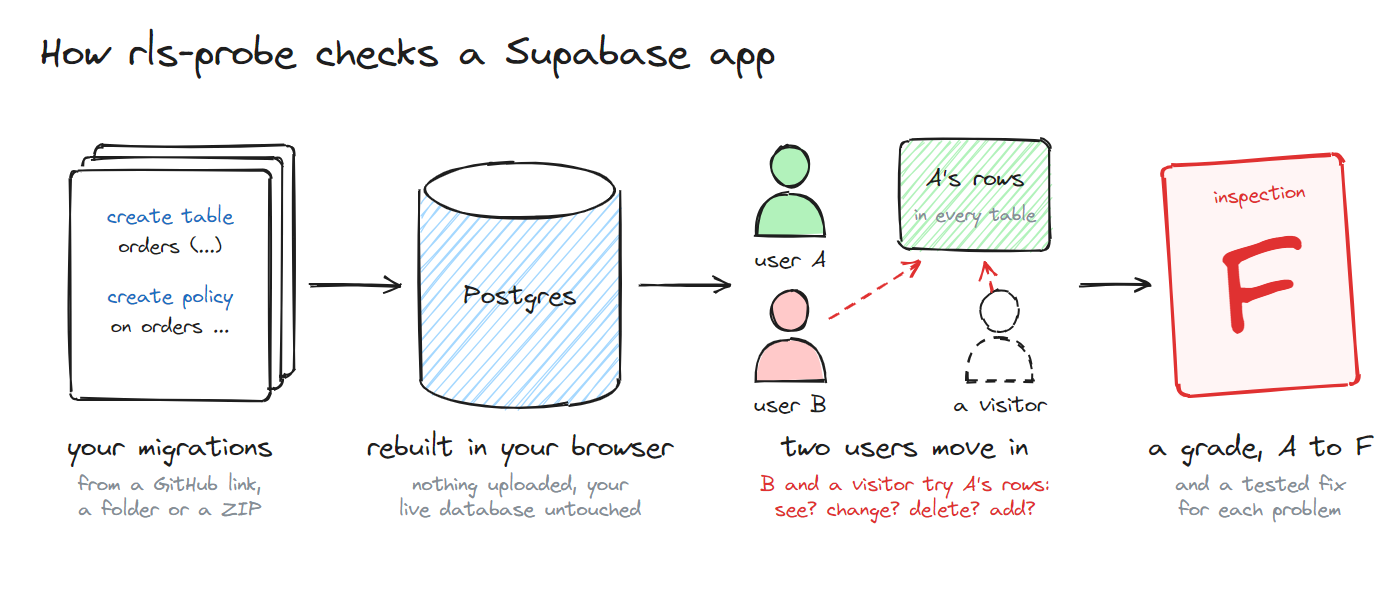
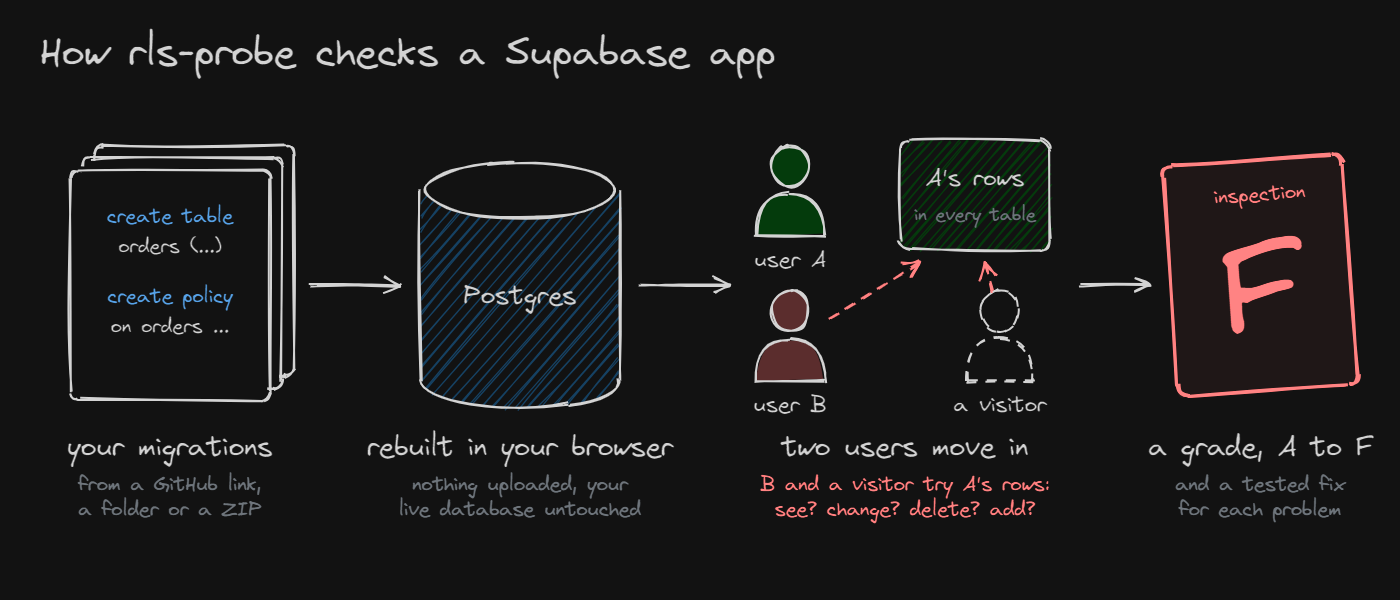
Find out in a few seconds. rls-probe rebuilds your app's database in this browser, signs in two test users, and tries to read and change each other's data. Then it tells you what to fix, in plain words. Nothing is uploaded.
Where's your app?
Drop your project folder or its ZIP here
From Bolt, use Download. From GitHub, Code, then Download ZIP. From Lovable, connect GitHub and use the link. The files stay on this computer.
Inspecting…
How an inspection works
- 1
Your database is rebuilt
Your migrations run in a real Postgres inside this browser, with the parts of Supabase your rules depend on. Your live database is never touched.
- 2
Two test users move in
Each gets rows of their own in every table. Then a visitor and the second user try to see, change, delete and add the first user's rows.
- 3
You get a grade and the fixes
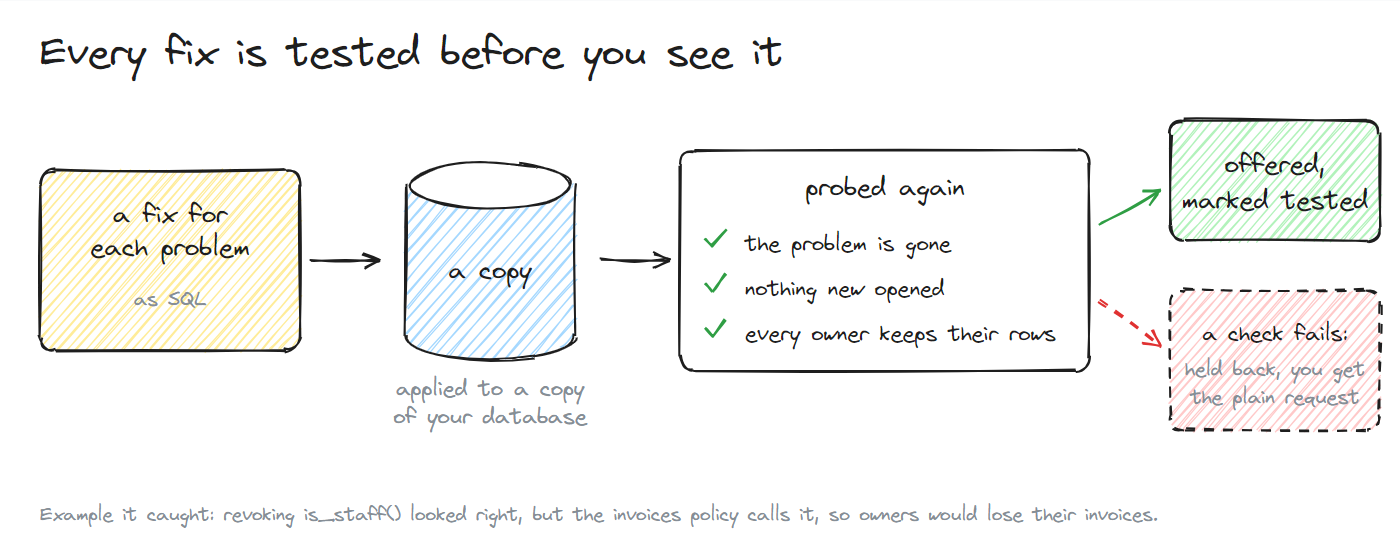
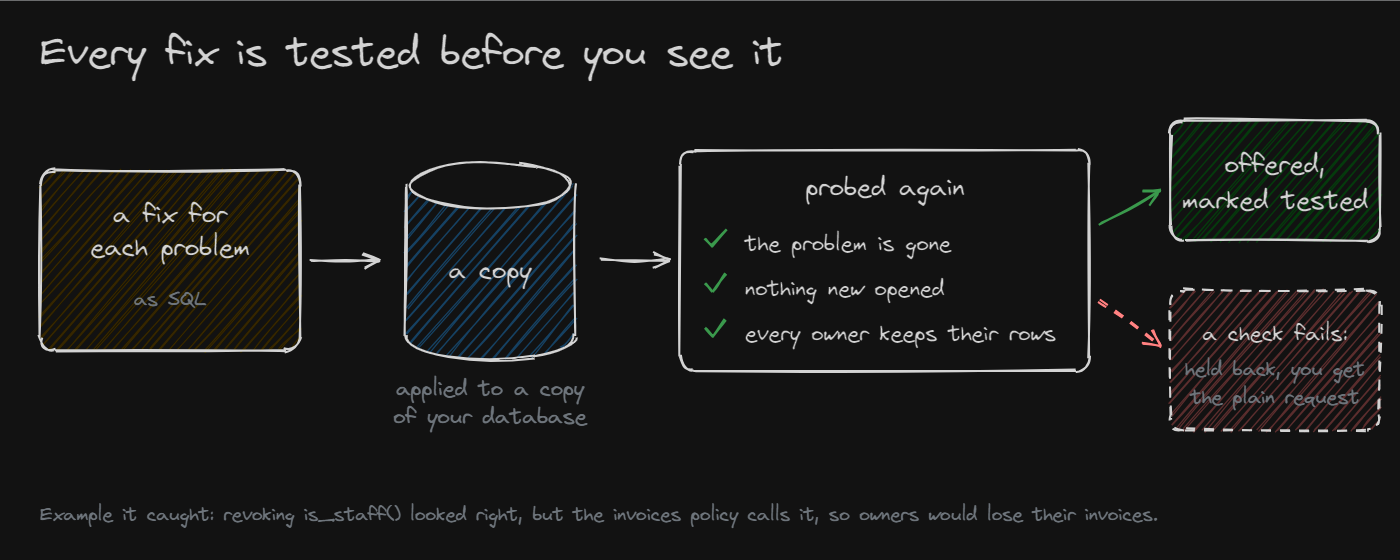
Each problem is explained in plain words, with a request you can paste into Lovable, Bolt, Cursor or Claude, and a fix that was tested on a copy of your database before you see it.
Is my code uploaded anywhere?
No. With a GitHub link, your browser reads the repository straight from GitHub. With a folder or ZIP, the files never leave your computer.
Does it touch my live database?
Never. It builds an empty copy from your migrations and tests that. None of your real data is read.
What doesn't it check?
Tables made only in the Supabase dashboard, which aren't in your migrations. It also can't know what you mean to be public, so some results are marked as worth checking rather than as problems.
What if a finding is wrong for my app?
It can be: a table may be public on purpose, or a policy changed in the dashboard. Paste the review into Claude Code, Cursor or Codex: it gives your agent the evidence for each finding and asks it to check against your code before fixing anything. Whatever doesn't apply goes in an rls-probe.json file with your reason, and stops counting.
Does it agree with a real Supabase?
It's tested against one. On a 15-table app built with Lovable, all 100 checks matched a real local Supabase. The fixes it suggests, the functions it calls and the teammate it adds were checked the same way: 136 of 136 matched.
Guides
- Fixing "permission denied" (42501) after October 30
Why new tables stopped answering, the fix that leaks data, and the one that doesn't.
- Is my Lovable app secure?
The holes most AI-built apps have, and how to check yours in a minute.
- Leaked your Supabase secret key?
Which keys are safe in the browser, and how to replace one that isn't.
For developers
The same inspection runs from the command line, in CI on every pull request, and as a tool your AI agent calls itself.
Command line
npx rls-probe .
Add --prompt for an AI builder, --fix-policies to write the tested fixes, --fix for the October 30 grants.
GitHub Action
- uses: zkousama/rls-probe@v0
Fails the build when a migration opens data.
Claude Code and MCP
/plugin install rls-probe ‑‑marketplace zkousama/rls-probe
Or npx rls-probe mcp in Cursor, Windsurf or Claude Desktop.